
Presbytery
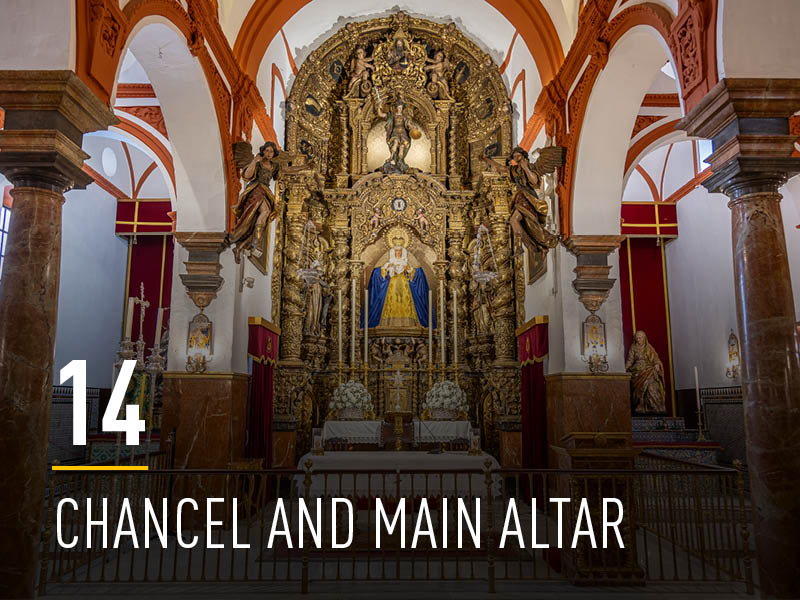
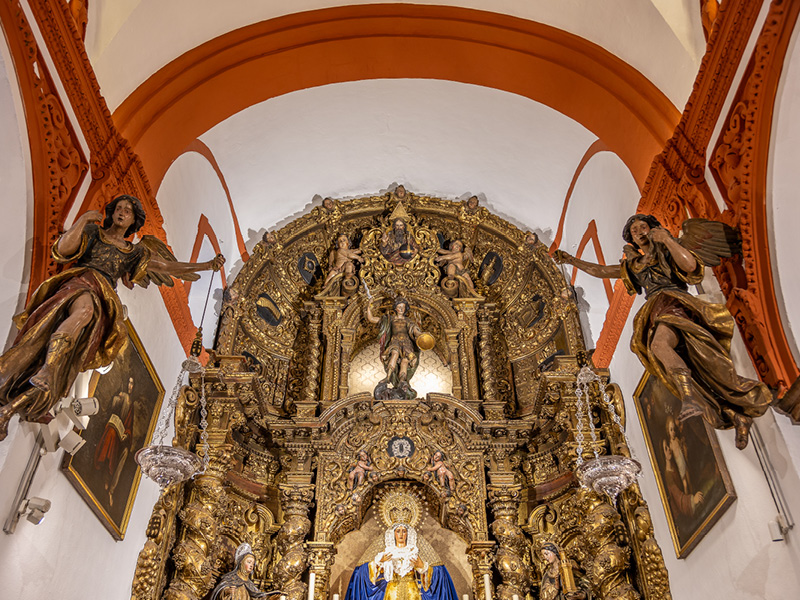
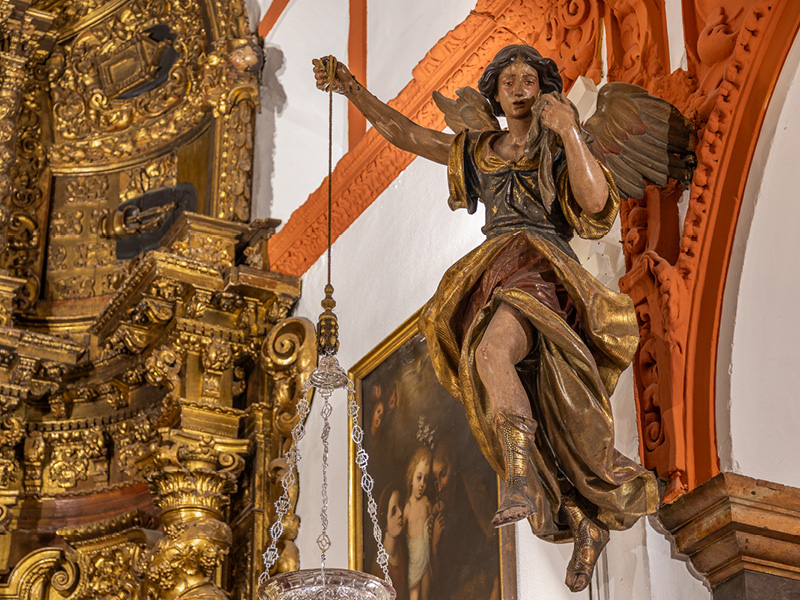
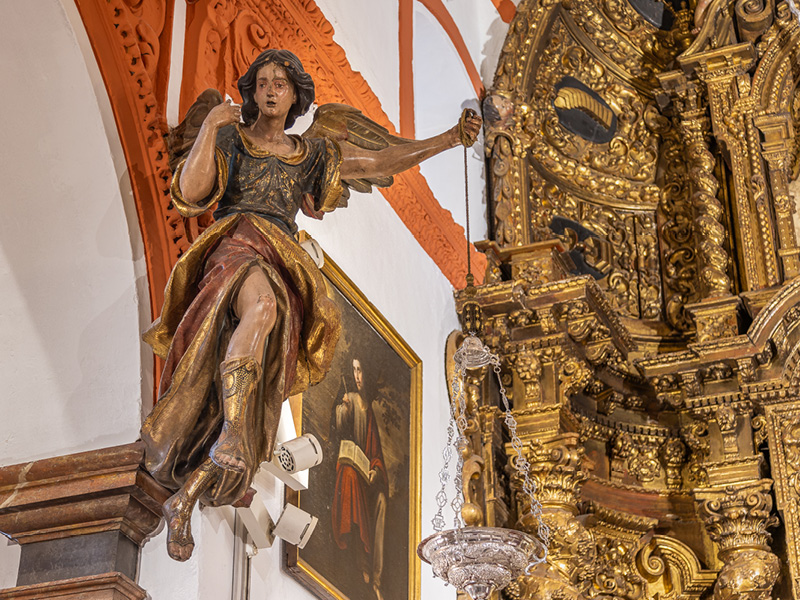
Before turning our attention to the main altarpiece, let us first look at the pair of extraordinary, almost life-size cherubs that flank the presbytery. Due to their artistic features, they are attributed to the sculptor Pedro Duque Cornejo. They were transferred from the Oratory of Saint Felipe Neri to the church in 1868.
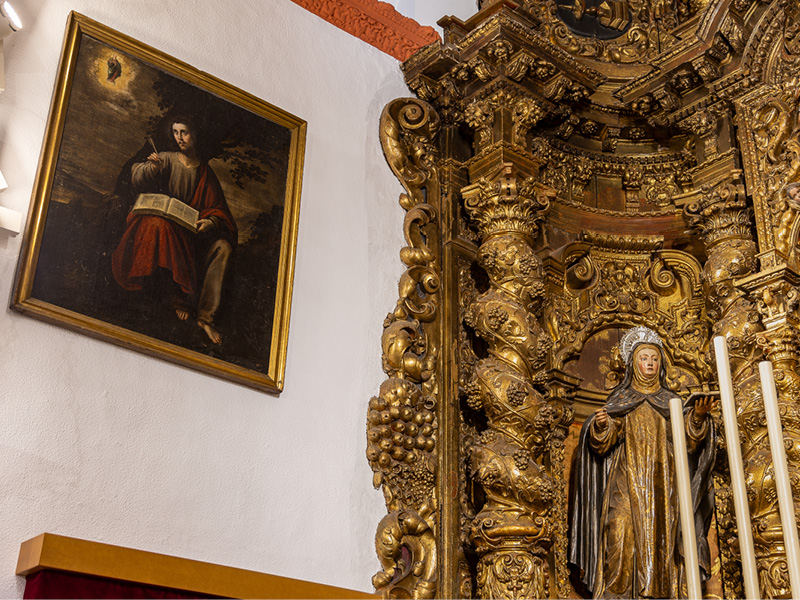
On the sides of the presbytery there are two paintings of great artistic interest. One of them depicts Saint John the Evangelist on Patmos, a work attributed to Murillo’s former teacher, the painter Juan del Castillo. This oil on canvas depicts the beloved disciple in the vision of the apocalyptic woman during the writing of the Book of Revelation. Dated around 1630, it is the oldest painting in the church.
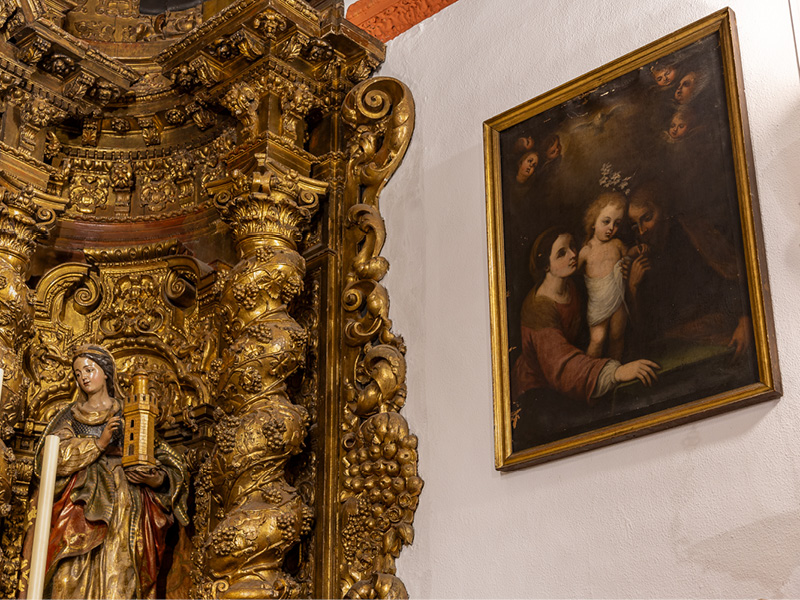
Opposite this painting is the Holy Family, a work dating from around 1680, which various experts have attributed to Juan Simón Gutiérrez, a painter from the last third of the 17th century who worked in Murillo’s circle and on whose models he based his compositions.
Main Altar
The main altarpiece was designed and executed by Miguel Franco, one of the outstanding masters of the transition from the 17th to the 18th century. The work was carried out between 1709 and 1716 in order to provide the new church with a main altar. In 1756, Juan Tejerizo was commissioned to carry out the gilding, which is a unique work of its kind and remarkable for many reasons. Its plan and design are concave, almost semicircular, creating an enveloping sensation and breaking the straightness of the flat front of the church. It is made up of a predella, a bench, a main body with three aisles and an attic, surrounded by a strong panels shell.
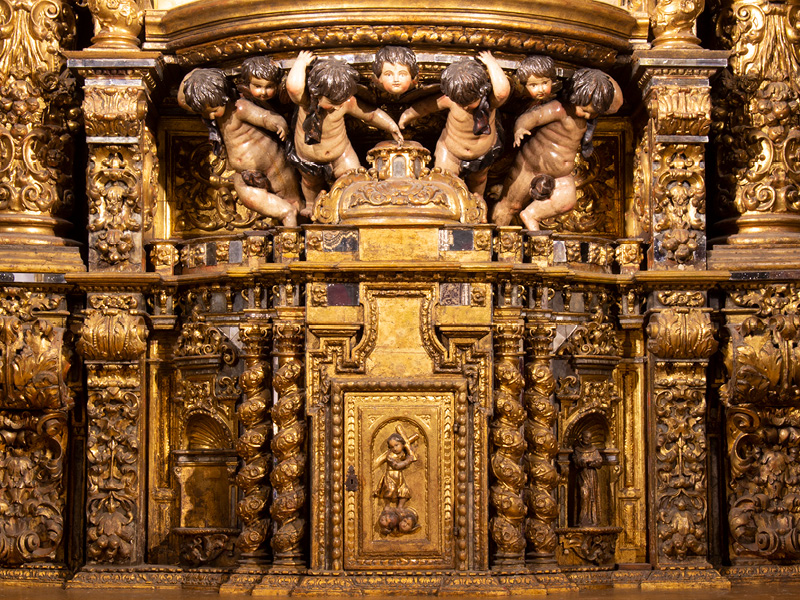
The predella, in red and black marble, has two semicircular doors that give access to the interior of the altarpiece, once connected to the old sacristy; above the altar table we can see the tabernacle, in the form of a small temple articulated by Solomonic columns, with a door the door that features a relief of the Child of the Passion. The bench is developed containing the corbels with tenant children, which support the columnar supports of the main body. These feature Solomonic columns from the imoscapo, which appears to be carved and crowned by composite capitals on which runs a mixtilinear cornice with inlets and outlets that curves and breaks in the central avenue of the altarpiece.
In the side aisles and on moulding and carved cornices, Saint Brigida of Ireland appears on the left and Saint Barbara on the right, supported by aedicules and broken and curled cornices. The “camarín” opens onto the church through a tri-lobed arch supported by Solomonic columns and set in a niche in which the emblem of the main devotion of the church stands out among angels, while the floor of the chapel is a large convex ledge held up by child angels in a dramatic composition. The use of mirrors throughout the lower part of the altarpiece, and especially in the chapel, is noteworthy, as it alleviates the lack of natural light in the church and therefore in the main altar, using them not only as an aesthetic element but also as a technical resource.
The upper part of the altarpiece is dominated by the Eucharistic Manifestation, which is located in the attic, a space that today serves as a secondary niche for the sculpture of Saint Michael the Archangel. Above it there are two large angels holding a cartouche with a relief of God the Father. The whole ensemble is encased in a cassette with Marian emblems. In short, this is a great altarpiece which, although it has undergone some important modifications, still retains much of its original splendour.
