


The façade
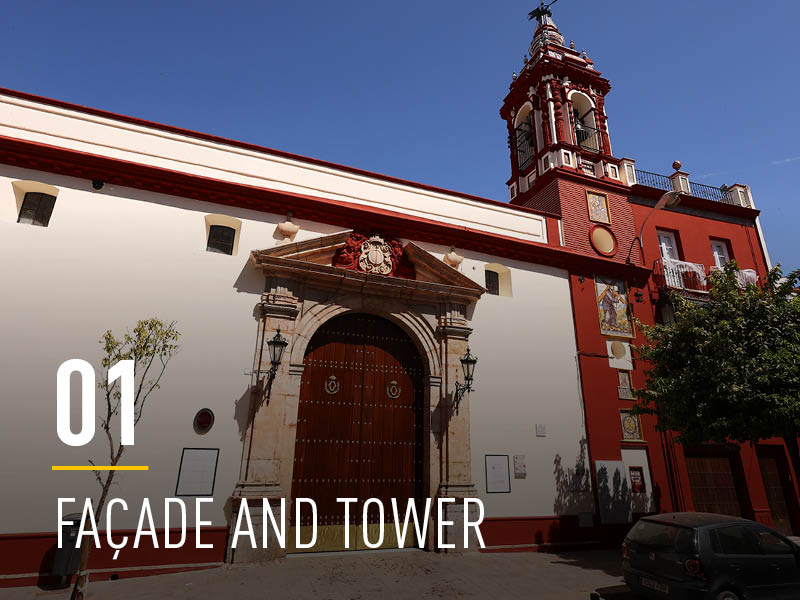
Welcome to the parish church of Nuestra Señora de La O. From the point of view of its location, the space it occupies is essentially limited by the banks of the Guadalquivir River and Castilla Street, the old royal road and natural entrance to Seville for those coming from the north, which limits not only the size and proportions of the church but also some of its formal characteristics. From the outside, the forms converge in a simple façade on Castilla Street, without altering the orientation of the façades of the neighbourhood.
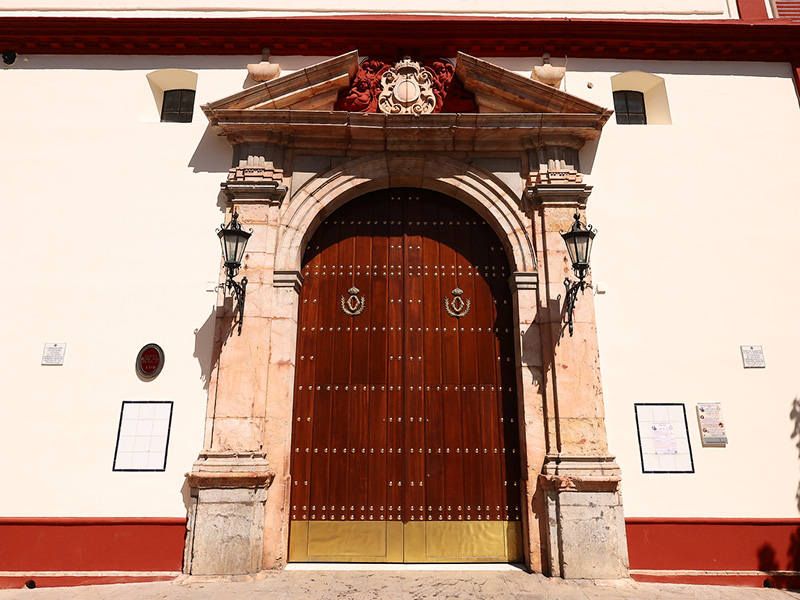
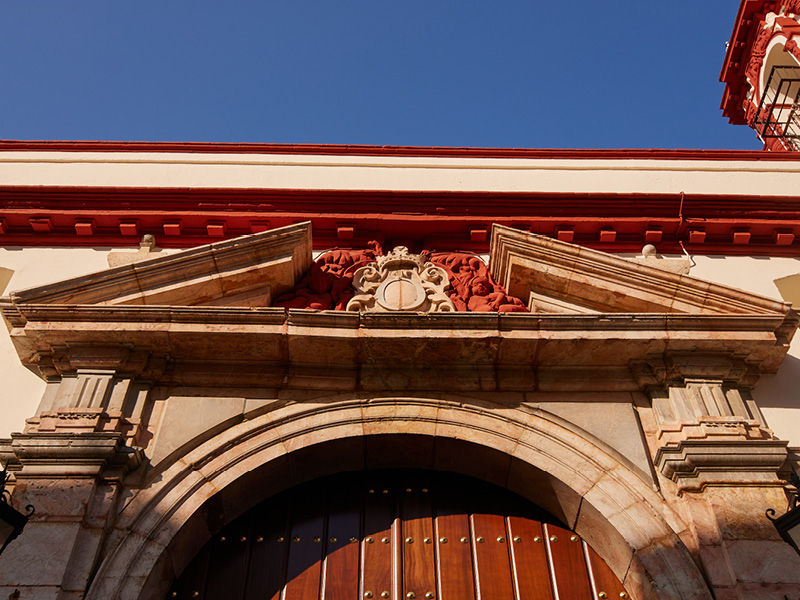
Please stand in front of the main door of the church, which has elegant lines and is made of black and red marble. It was sculpted by Antonio Gil Gataón and is based on two Tuscan pilasters that frame the arch, all on podiums, with entablature dadoes with their corresponding triglyphs, topped by a broken triangular pediment that contains a cartouche with the coat of arms of La O, crowned and flanked by two infant figures carved in mortar.
The Tower
The elegant, slender tower on the right is one of the most singular elements of the whole building. It begins with an almost cubic body placed on the cornice of the façade, starting from a masonry pilaster that serves as a cane, and in which various light openings are interspersed with ceramic panels that are literally a compendium of the identity and history of the Archconfraternity.
Of these, the one that reproduces the image of Nuestro Padre Jesús Nazareno stands out, as it is the oldest ceramic tile depicting the main devotion of a Sevillian brotherhood. It dates from 1760.
The current bell tower and steeple are the result of two stages. The first coincides with the time when the church was built in 1699, and the second is the result of the reconstruction it underwent after the Lisbon earthquake of 1755.
The bell tower has four semicircular openings framed by mouldings to house the bells. The articulation of this volume has been resolved by means of a square podium with projections and recesses that house ceramic panels. The elevation is made up of half-Solomonic columns with a straight and grooved imoscapo, supported by pilasters.
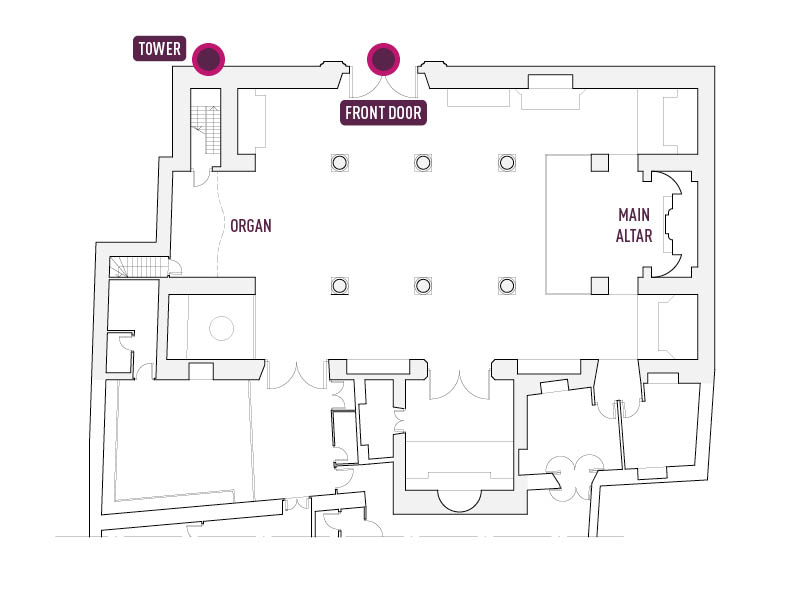
Please enter the church and stand in front of the organ, facing the main altar.
